 |
Procedures for Subcontracted Worker Unions to Participate in Collective Bargaining
Bongsoo Jung (Korean labor attorney, KangNam Labor LawFirm)
I. Introduction
Article 2 of the amended Labor Union Act explicitly provides that: “‘Employer’ means a business owner, a person in charge of managing the business, or a person who acts on behalf of the business owner with respect to matters concerning the employees of the business. In this case, even a person who is not a party to the employment contract shall be deemed an employer to the extent that such person is in a position to practically and specifically control or determine the working conditions of employees.” Under this expanded concept of employer, even where there is no direct employment contract relationship, if a principal contractor is in a position to practically and specifically control or determine the working conditions of employees of a subcontracting company, the principal contractor is deemed to be an employer. Accordingly, a labor union composed of subcontracted workers may demand collective bargaining with the principal contractor and conclude a collective agreement. In this process, if the principal contractor, as an employer, refuses a request for collective bargaining from a subcontracted worker union, such refusal constitutes an unfair labor practice due to refusal to bargain collectively. In response to such unfair labor practices by the principal contractor, not only may applications for remedial relief be filed, but criminal punishment may also be sought. Therefore, principal contractors must fulfill their obligations as employers in accordance with the revised concept of employer.
In this regard, Article 29-2 of the Labor Union Act provides that: “In cases where two or more labor unions established or joined by employees exist in a single business or workplace, regardless of their organizational form, the labor unions shall designate a bargaining representative union and request bargaining.” Accordingly, although subcontracted workers’ unions have the right to request collective bargaining, they are required to request bargaining through a single bargaining channel by forming one bargaining window. Notwithstanding this provision, where subcontracted worker unions require separate bargaining due to significant differences in working conditions, types of employment, or other factors within the workplace, they may engage in separate bargaining upon approval by the Labor Relations Commission. In particular, since subcontracted worker unions are composed of workers from multiple subcontracted companies, it is anticipated that many applications for the separation of bargaining channels will arise.
In this context, this article seeks to examine in detail the procedures and methods of the bargaining channel unification process for subcontracted worker unions, together with the system for separation of bargaining channels.
II. Procedures for the Unification of Bargaining Channels for Subcontracted Worker Unions
When a subcontracted worker union requests collective bargaining, (i) the employer must announce the fact of the bargaining request and confirm the participating unions. Thereafter, (ii) the employer must allow a period of 14 days for the labor unions participating in bargaining to autonomously form a bargaining delegation. In cases where the subcontracted worker unions participating in bargaining fail to autonomously form a bargaining delegation, the employer shall select a majority union from among the labor unions participating in bargaining and designate it as the bargaining representative union.
1. Request for Bargaining by a Labor Union and Confirmation of Participating Unions
Special rule for calculation of periods: Pursuant to Article 161 of the Civil Act, where the last day of a period falls on a Saturday or a public holiday, the period shall expire on the following day.
(1) Request for Bargaining by a Subcontracted Worker Union (Labor)
Any labor union that wishes to engage in bargaining with the employer may request bargaining in writing, stating its name, number of members, and other relevant details, from the date that is three months prior to expiration date of the collective agreement (Enforcement Decree of the Labor Union Act, Article 14-2).
(2) Public Announcement of the Fact of the Bargaining Request (Employer)
An employer that has received a bargaining request must publicly announce the fact of the bargaining request for seven days from the date of receipt on the bulletin board of the relevant business or workplace, or by other means. Even if the employer believes there is only one labor union at the relevant business or workplace, employees may be members of industry-based or regional unions; therefore, the employer must announce the fact of the bargaining request.
(3) Application by Other Labor Unions to Participate in Bargaining (Labor)
Applications must be made within the announcement period for the fact of the bargaining request (seven days from the date of announcement). If a labor union fails to request bargaining within this period, it may not participate in the bargaining channel unification procedure. Within this period, a subcontracted worker union may request corrective measures from the Labor Relations Commission by asserting the employer status of the principal contractor, even in the absence of a contractual relationship. The Labor Relations Commission must decide within 10 days whether the principal contractor is in a position to practically and specifically control or determine the working conditions of the subcontracted workers. However, where such a determination is difficult, the period may be extended up to 10 additional days, during which the employer status of the principal contractor with respect to the subcontracted worker union must be confirmed (Enforcement Decree of the Labor Union Act, Article 14-3).
(4) Public Announcement Confirming Participating Unions (Employer)
The employer must make a public announcement for five days starting from the day following the end of the announcement period for the fact of the bargaining request. Only labor unions confirmed as bargaining-requesting unions may participate in the procedure for determining the bargaining representative union and may file applications for correction regarding violations of the duty of fair representation.
Where a subcontracted worker union raises an objection to the employer’s determination of participating labor unions, it may request corrective measures from the Labor Relations Commission. In response, the Labor Relations Commission must render a decision on the requested matter within 10 days; where it is difficult to render a decision within that period, the period may be extended up to 10 additional days (Enforcement Decree of the Labor Union Act, Article 44-5).
2. Determination of the Bargaining Representative Labor Union
Special rule for calculation of periods: Pursuant to Article 161 of the Civil Act, where the last day of a period falls on a Saturday or a public holiday, the period shall expire on the following day.
(1-1) Voluntary Unification (Labor)
After the bargaining-requesting unions are confirmed, the labor unions shall voluntarily determine the bargaining representative union within 14 days from the date on which the bargaining-requesting unions are confirmed or determined. With respect to the method of voluntary unification among labor unions, there are no specific procedures or restrictions; therefore, any method may be freely chosen as long as it reflects the unanimous intent of the participating unions (Enforcement Decree of the Labor Union Act, Article 14-6).
(1-2) Notification of Majority Union (Labor)
A majority union refers to a union that accounts for a majority of the total members of all labor unions participating in the bargaining channel unification procedure. Even if there is no single majority union, where two or more unions, through delegation, alliance, or other methods, together account for a majority of the total union members, they shall also be recognized as a majority union. A union claiming to be a majority union must notify the employer that it is the bargaining representative union, as the union accounting for a majority of the total union members, within five days from the date on which the period for voluntary unification expires (Enforcement Decree of the Labor Union Act, Article 14-7).
(2) Public Announcement of Notification (Employer)
Where the employer receives notification that a union has been chosen as the majority labor union, the employer must publicly announce the details of such notification for five days from the date of receipt of such notification so that other unions and employees are aware of this fact.
(3) Joint Bargaining Representative Group (Voluntary or Labor Relations Commission)
Where there is no majority labor union, the confirmed bargaining-requesting unions must form a joint bargaining representative group and request bargaining with the employer. The joint bargaining representative group shall be formed voluntarily by the labor unions. If no agreement is reached, it shall be formed in accordance with a decision of the Labor Relations Commission (Enforcement Decree of the Labor Union Act, Articles 14-8 and 14-9). Eligibility to participate in the joint bargaining representative group is limited to those unions whose membership accounts for at least 10% of the total membership of all unions participating in the bargaining channel unification procedure. Labor unions whose membership accounts for less than 10% of the total union membership, and their members, shall still be subject to the collective agreement concluded by the joint bargaining representative group with the employer, and shall also be eligible to participate in strike authorization votes.
III. Separate Bargaining through the Separation of Bargaining Channels for Subcontracted Worker Unions
1. Legal Basis
Since two or more labor unions may be established in a single workplace, conflicts could arise between them if the employer were to bargain individually with each of them, and adverse effects such as increased bargaining costs for the employer would be expected. In order to prevent this, current law provides that, where two or more unions of the same organizational form exist in a single business or workplace, a bargaining representative union shall be designated to request bargaining (Article 29-2 of the Labor Union Act). In other words, the principle of “one company, one bargaining representative union” is adopted. Nevertheless, where there are significant differences in working conditions, types of employment, bargaining practices, and the like within a single business or workplace, separating bargaining units may help avoid conflicts between labor unions and contribute to the improvement of employee working conditions. In line with this purpose, where it is recognized that there is a need to separate bargaining units, bargaining units may be separated upon obtaining approval from the Labor Relations Commission (Article 29-3 of the Labor Union Act).
In accordance with expansion of the definition of “employer,” when subcontracted worker unions that do not have an employment contract relationship request bargaining, and when determining whether to separate bargaining channels or to integrate separated bargaining units, the following items shall be considered as criteria (Enforcement Decree of the Labor Union Act, Article 14-11):
① Significant differences exist in working conditions arising from the nature and content of work, work environment, degree of responsibility, wage system, components and method of payment, working hours, holidays and leave, welfare benefits, remuneration and service regulations, and the like;
② Significant differences exist in type of employment based on contract form and method, job category, recruitment method, retirement age, whether there is personnel interchange, and the like;
③ Significant differences exist in bargaining practices based on the scope of eligibility for union membership and union member qualifications, the scope of employees who have joined labor unions, whether and how labor-management consultations such as existing collective bargaining have been conducted, and the scope of application of bargaining subjects;
④ Matters exist that are recognized as necessitating the separation of bargaining units or integration of separated bargaining units for reasons equivalent to those set forth in items ① through ③.
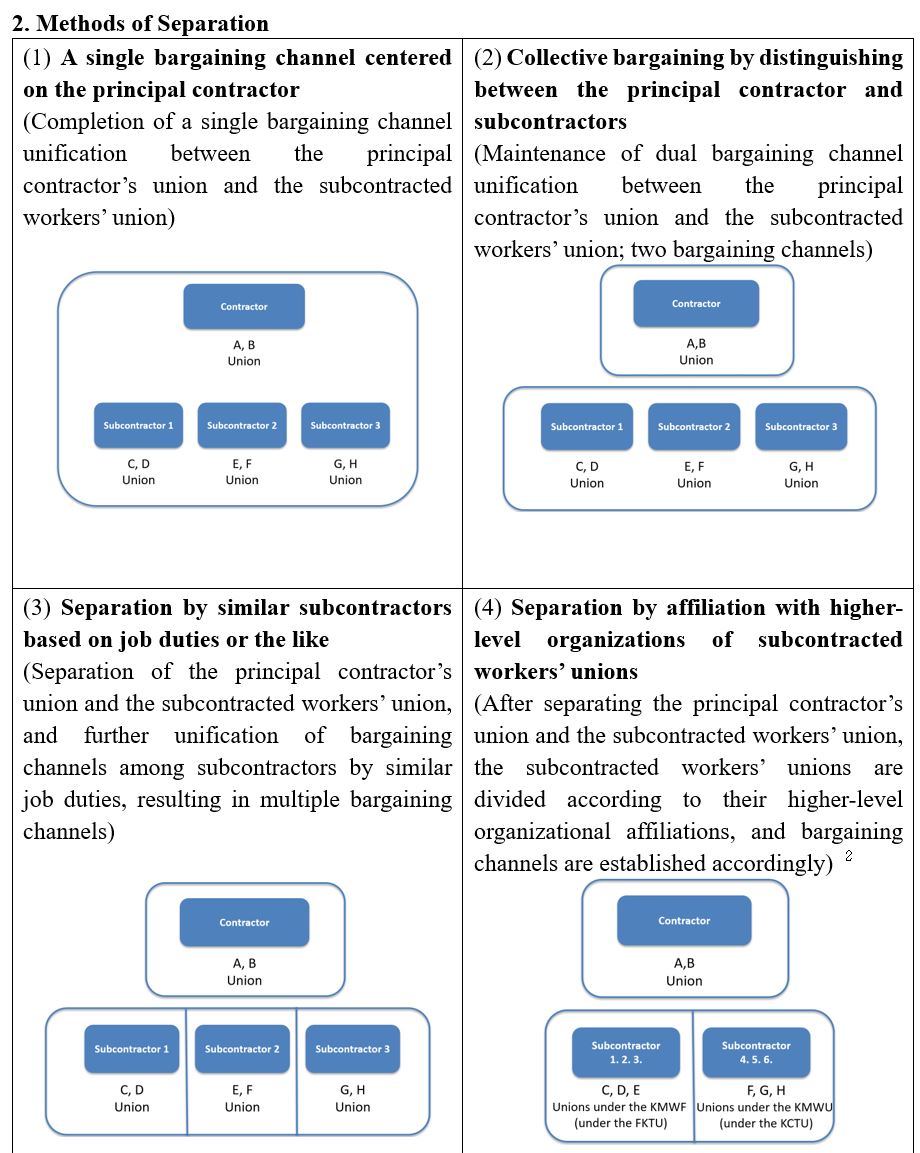
2. Methods of Separation
(1) A single bargaining channel centered on the principal contractor
(Completion of a single bargaining channel unification between the principal contractor’s union and the subcontracted workers’ union)
(2) Collective bargaining by distinguishing between the principal contractor and subcontractors
(Maintenance of dual bargaining channel unification between the principal contractor’s union and the subcontracted workers’ union; two bargaining channels)
(3) Separation by similar subcontractors based on job duties or the like
(Separation of the principal contractor’s union and the subcontracted workers’ union, and further unification of bargaining channels among subcontractors by similar job duties, resulting in multiple bargaining channels) (4) Separation by affiliation with higher-level organizations of subcontracted workers’ unions
(After separating the principal contractor’s union and the subcontracted workers’ union, the subcontracted workers’ unions are divided according to their higher-level organizational affiliations, and bargaining channels are established accordingly)
3. Procedures for the Separation of Bargaining Units
(1) Eligible Applicants
An application for the separation of bargaining units may be filed jointly by the company and its labor unions, as the parties to labor relations, and may also be filed unilaterally by either the labor unions or the company (Article 29-3 of the Labor Union Act). Labor unions that did not participate in the bargaining channel unification procedure may also apply for the separation of bargaining units, as may branch unions or sub-branches under an industrial union (Enforcement Decree of the Labor Union Act, Article 14-11).
(2) Timing of Application
A labor union or an employer may apply for a decision on the separation of bargaining units (i) before the employer publicly announces the fact of the bargaining request, or (ii) if the employer has publicly announced the fact of the bargaining request, after the date on which the bargaining representative union has been determined (Enforcement Decree of the Labor Union Act, Article 14-11). Accordingly, except for the period during which the bargaining channel unification procedure is in progress, an application for a decision on the separation of bargaining units may be filed at any time.
(3) Effect of Application
Where the Labor Relations Commission receives an application for the separation of bargaining units, it shall notify all labor unions and the employer of the relevant business or workplace of the contents thereof and request that they submit their opinions. The Commission shall render a decision on the separation of bargaining units within 30 days from the date of receipt of the application. Where such an application is filed, the progress of the bargaining channel unification procedure shall be suspended (Enforcement Decree of the Labor Union Act, Article 14-11).
(4) Effect of Decision
Where the Labor Relations Commission renders a decision to separate bargaining units, the labor union may request collective bargaining from the employer. In such cases, the employer that has received a request for collective bargaining must recommence the bargaining channel unification procedure from the beginning for each separated bargaining unit. However, where there is an existing collective agreement, collective bargaining may be requested from the date that is three months prior to expiration date of the validity period of that collective agreement (Enforcement Decree of the Labor Union Act, Article 14-11).
(5) Objection Procedures and Standards
The provisions governing procedures for objecting to the arbitration decisions by the Labor Relations Commission on the separation of bargaining units shall apply mutatis mutandis (Articles 29-3 and 69 of the Labor Union Act). Accordingly, an objection may be filed with the National Labor Relations Commission within 10 days only where the decision of the Labor Relations Commission on whether to separate bargaining units is illegal or constitutes an abuse of authority.
The Supreme Court has held that: “An arbitration award may be contested only where the procedure thereof is illegal, where the content thereof is illegal due to a violation of the Labor Standards Act or the like, or where the arbitration award is rendered illegally or in excess of authority, such as in cases where it addresses matters that are not the subject of a dispute between the parties or, without justifiable grounds, goes beyond the scope of the dispute between the parties. An arbitration award is not subject to challenge merely because it contains provisions that are unfavorable to one party.”
|








 Connect to the app