
“Apply the Labor Standards Act to All Workers”: Special Employment and Platform Workers Rally at the Presidential Office Workers demand minimum remuneration standards and legislation to protect designated drivers, while voicing opposition to the pro
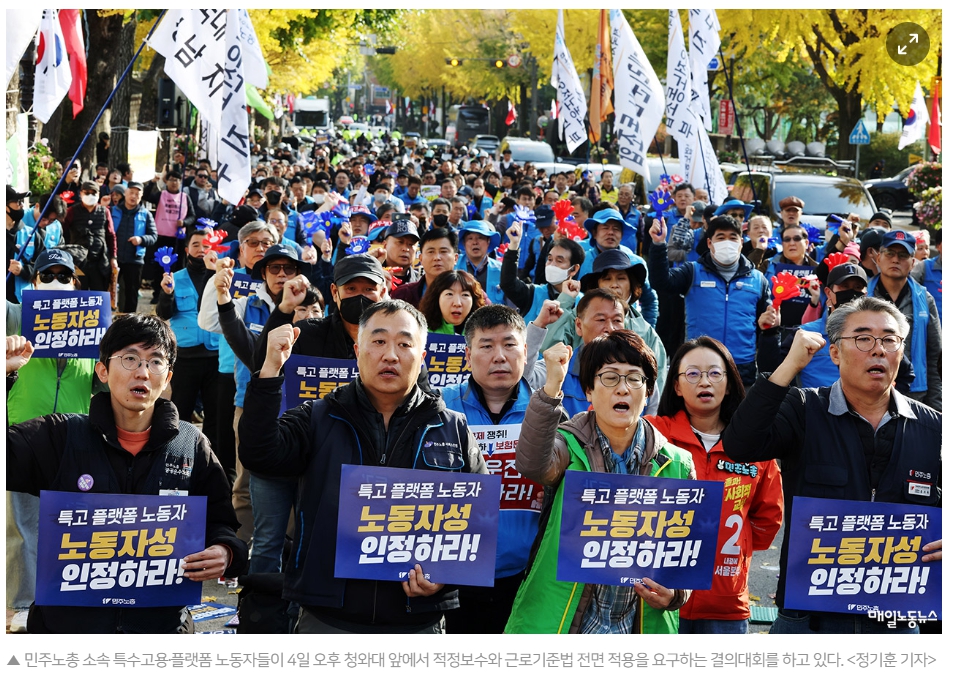
“Companies issue all kinds of work instructions to us, yet our contracts classify us as ‘independent business operators.’ They directly manage and control us, telling us things like ‘Attend the meeting by a certain time’ and ‘Share your performance results in the group chat.’ Nevertheless, they refuse to assume the responsibilities toward workers prescribed by the Labor Standards Act.”
These were the words of Ms. Jung Nan-sook, who has worked as a home-study teacher for 30 years. She spoke at a rally organized by the Korean Confederation of Trade Unions (KCTU) in front of the Presidential Office on the afternoon of November 4. Ms. Jung explained that she faces constant pressure to meet performance targets and must satisfy company-imposed criteria each year to renew her contract, yet she is denied basic labor rights. “We are not even recognized as workers, and no matter how hard we work, we cannot receive fair compensation,” she lamented.
Approximately 500 Special Employment and Platform Workers Gather for Rally
Approximately 500 special employment and platform workers from across the country gathered in front of the Presidential Office, according to estimates by the organizers. Participants included home-study teachers, delivery riders, designated drivers, insurance agents, home appliance maintenance workers, freight transport workers, and construction workers.
They collectively demanded:
“Apply the Labor Standards Act to all workers!”
“Ratify the International Labour Organization (ILO) Convention on Platform Work!”
The participants argued that anyone who actually provides labor should be protected under the Labor Standards Act, regardless of the contractual form of their employment. Approximately 8.7 million special employment and platform workers who do not receive adequate protection under the current Labor Standards Act face difficulties securing fundamental rights relating to wages, working hours, holidays, and paid leave. In particular, the protesters expressed strong opposition to the Basic Act on Working People, which the Lee Jae-myung administration is pursuing. They argued that the proposed legislation lacks practical effectiveness and merely establishes abstract principles.
Hong Ji-wook, an executive committee member of the KCTU's Emergency Response Committee, stated:
“Instead of introducing a new Basic Act on Working People, the government should properly amend the Labor Standards Act and establish a legal presumption of employee status to expand recognition of workers.”
The demonstrators also called for ratification of ILO Convention No. 193 concerning decent work in the platform economy, which they said had been adopted in June. According to the protesters, the Convention addresses the employment status of special employment and platform workers and provides protections relating to occupational health and safety, including the right to stop dangerous work, minimum remuneration, and access to information about algorithms.
They urged President Lee Jae-myung to begin by ratifying the Convention if he genuinely intended to listen to the concerns of special employment workers.
“We Have No Way of Knowing How Delivery Fees Are Calculated”
Delivery riders demand algorithmic transparency and minimum remuneration standards.
Before the main rally, Riders Union, led by branch president Koo Kyo-hyun, held a separate demonstration outside the Seoul Regional Employment and Labor Office in Jung-gu, Seoul, on the afternoon of November 4.
The union demanded greater transparency in delivery fee calculations and the introduction of a minimum remuneration system.
Delivery workers criticized the lack of transparency surrounding delivery fees, which they described as a “black box.”
They explained that compensation may vary from day to day even when the delivery distance is identical, while additional payments based on distance are calculated inconsistently. One major issue is the so-called overlapping-distance deduction. Currently, when riders simultaneously deliver two orders along similar routes, the additional distance-based payment for one of the deliveries may be calculated arbitrarily.
According to examples released by the union, a rider traveled a total of six kilometers to complete two deliveries. For one order, the full six kilometers qualified for additional distance-based compensation. However, only 1.6 kilometers were recognized for the other order.
This meant that just 27% of the actual travel distance was reflected in the calculation.
In another case, a rider traveled five kilometers, but only 1.6 kilometers, or 32%, was recognized for one delivery. There were even cases in which the recognized distance was zero kilometers.
The basis for these calculations was not disclosed.
Lee Dae-geun, vice president of Riders Union, criticized the system:
“Even when delivery routes overlap, the work involved in picking up and delivering orders remains the same. We have absolutely no idea how delivery fees are calculated or why they are reduced. Platforms determine both job assignments and delivery fees at their own discretion, effectively exercising direction and supervision over us.”
Demand for a Minimum Remuneration System As an alternative, delivery riders proposed introducing a minimum remuneration system.
Under their proposal, the minimum payment level would reflect both the expenses necessary to perform delivery work, including fuel and insurance, and the time actually required, including delivery time, restaurant preparation delays, and waiting for orders.
They also demanded that workers and trade unions be allowed to participate in determining remuneration standards and that delivery platforms be legally required to comply with them.
Koo Kyo-hyun, president of Riders Union, stated:
“To make up for reduced delivery fees, riders have no choice but to drive faster and work longer hours. That is why delivery riders rank first in industrial accident claims.”
He emphasized that low delivery fees are not merely a matter of livelihood but also a matter of life and safety.
Designated Drivers Call for Enactment of a Dedicated Law
Proposed legislation would establish standard fares and limits on intermediary commissions
Designated drivers called for the enactment of a dedicated Designated Driving Services Act to ensure appropriate remuneration. They demanded that the law clearly establish business operators' obligations and liabilities, including limits on intermediary commissions and prohibitions against unfair restrictions on job assignments. The Lee Jae-myung administration has included the preparation of a draft Designated Driving Services Act among its national policy objectives under the initiative titled “Workplaces Free from Discrimination and Exclusion.”
At a rally near the Presidential Office Sarangchae building, the Designated Drivers' Union, headed by president Lee Chang-bae, stated:
“For 20 years, we have demanded legislation to protect designated drivers. However, repeated attempts at legislation have failed to pass the National Assembly. Meanwhile, we have continued to suffer from low fares, high commissions, and numerous expenses imposed on us.”
According to the union, although designated drivers are classified as persons engaged in special types of employment, they effectively work under platform companies and intermediary agencies.
They often work at least eight hours per day and 26 days per month, primarily at night, and must comply with dress codes and customer service rules imposed by business operators.
Approximately 20% of their driving fees are deducted as intermediary commissions.
When management fees, software usage charges, and insurance premiums are included, approximately 40% of their earnings are paid to business operators or associated service providers.
Introduction of Standard Fares and Commission Caps. The union demanded the establishment of a standard fare system reflecting both actual driving time and waiting time.
The objective is to ensure appropriate remuneration and prevent workers' effective hourly earnings from falling below the statutory minimum wage. The union also called for compensation standards covering canceled assignments and prolonged waiting periods. To reduce excessive intermediary fees, it proposed legally binding commission caps. It further demanded restrictions on shifting management and software costs onto drivers and on forcing them to purchase paid services. The union also proposed mandatory standard contractual terms addressing fares, commissions, insurance, job assignments, and contract termination.
Under the proposal, business operators would be legally required to comply with these standards. Opposition to Unilateral Control of Job Assignments The union also criticized the unilateral control exercised by platforms over job assignments.
“Platform companies and intermediary agencies use algorithms and rating systems to control opportunities to work, yet they refuse to take responsibility for workers' livelihoods and safety,” the union stated. It demanded disclosure of job assignment algorithms and selection criteria. It also called for prohibitions against unilateral contractual changes or termination, unfair restrictions on job assignments, discrimination, and the improper transfer of liability for damages to drivers. To reduce insurance costs, the union proposed establishing a mutual insurance association for designated drivers, with worker participation and financial contributions from business operators.
Union president Lee Chang-bae emphasized:
“The central purpose of the legislation must be to provide the worker protections promised under the government's national policy agenda. These protections must not be replaced merely by mutual insurance benefits or the proposed Basic Act on Working People.”
Source: Maeil Labor News (매일노동뉴스) Reporter: Eom Jae-hee Published: November 5, 2026, 6:30 AM
Original website: www.labortoday.co.kr
| No | Title | Date | Access | File |
|---|---|---|---|---|
| 375 | Notice A Pioneer of Korean-English Labor Law Content: [Interview] Bongsoo Jung, Certified Labor Attorney at KangNam Labor Law Firm | 25.07.25 | 8551 |

|
| 374 | Notice 10 Top Lawyers In Seoul For English-Speaking Foreigners (April 27, 2022): KangNam Labor Law Firm was selected as one of ten best law firms in Seoul by the International Magazine. | 25.03.07 | 7030 |
|
| 373 | Notice · Event: Kangnam Labor Law Firm 2026 Fall HR Forum · Theme: Labor Risk Outlook and Strategic HR Directions for Businesses in the AI Era | 26.10.25 | 469 |
|
| 372 | Notice Kangnam Labor Law Firm and B&H Tax Accounting Firm Sign MOU for Strategic Business Cooperation On October 13, 2026 | 26.10.20 | 410 | |
| 371 | Notice Regarding Legislation to Extend the Mandatory Retirement Age: A Conversation between Dr. Jun-Ki Han and Labor Attorney Bongsoo Jung | 26.09.03 | 396 | |
| 370 | Improvement of Workplace Culture N | 26.11.10 | 4 | |
| “Apply the Labor Standards Act to All Workers”: Special Employment and Platform Workers Rally at the Presidential Office Workers demand minimum remuneration standards and legislation to protect designated drivers, while voicing opposition to the pro N | 26.11.10 | 57 |
|
|
| 368 | Seven in Ten Employees Say the Inclusive Wage System Should Be Banned 31% of Employees Say They Are Not Properly Paid for Overtime, Night Work, and Holiday Work N | 26.11.04 | 252 |
|
| 367 | Korean Metal Workers’ Union Calls for an End to Rulings Narrowing the Scope of Illegal Dispatch and Delays in Court Proceedings Subcontracted Workers from Hyundai Steel, Hyundai Motor and Other Companies Hold Press Conference in Front of the Supreme | 26.11.02 | 367 |
|
| 366 | November 1st week - Labor Case: Dismissal Based on a Poor Performance Evaluation | 26.11.01 | 388 |

|
| 365 | Who Gets Promoted to Executive Positions? What Qualifications and Leadership Skills Are Required? | 26.11.01 | 412 |
|
| 364 | Justified and Unfair Dismissal ? Legal Standards and Practical Responses ? While preparing the third revised edition of the Dismissal Manual, I wrote an introductory article. | 26.10.29 | 527 | |
| 363 | Employee Resignation and Job Transition Management ? Perspectives of Employees and Employers | 26.10.28 | 572 | |
| 362 | Number of Suspected “Disguised Workplaces with Fewer Than Five Employees” More Than Doubles in Seven Years Nearly 150,000 Suspected Workplaces Identified in 2025, Concentrated in the Restaurant and Accommodation Sectors ? Calls for Financial Penalti | 26.10.28 | 558 |
|
| 361 | Labor Management for Small and Medium-Sized Enterprises (SMEs) | 26.10.27 | 605 |
|
| 360 | Failure to Reduce Wage Inequality: Wage Gap Between Regular and Non-Regular Workers Reaches Record High August Supplementary Survey by Employment Type Shows Nearly Twofold Wage Difference … Number and Proportion of Non-Regular Workers Also Reach Rec | 26.10.26 | 699 |
|
| 359 | ·Event: Kangnam Labor Law Firm 2026 Fall HR Forum · Theme: Labor Risk Outlook and Strategic HR Directions for Businesses in the AI Era | 26.10.25 | 639 |
|
| 358 | Human Resource Management, Compensation Policy: | 26.10.24 | 595 | |
| 357 | Fundamental Principles of Human Resource Management: The Right Person in the Right Job and Effective Recruitment Procedures | 26.10.21 | 773 | |
| 356 | Kangnam Labor Law Firm and B&H Tax Accounting Firm Sign MOU for Strategic Business Cooperation On October 13, 2026, | 26.10.20 | 677 |