
[Roundtable on the Amended Trade Union Act ? Manufacturing Subcontractor Unions] “We Followed the Labor Ministry’s Guidelines, Only to Be Blocked by the Court” What Are the Concerns of Subcontractor Unions at Donghee Auto, Hankook Tire, Hanwha Ocean
Although the amended Trade Union and Labor Relations Adjustment Act (TULRAA) has opened the door to collective bargaining between subcontractor unions and principal contractors, critics argue that it still falls short of ensuring meaningful negotiations.
While the government’s intention to facilitate collective bargaining through the Enforcement Decree is acknowledged, limitations have emerged at workplaces, where negotiations have been delayed or obstructed by court decisions.
Union representatives from manufacturing subcontractors say they intend to make use of the existing legal framework and procedures while concentrating on strengthening their internal organizational capacity around subcontracted workers’ demands to achieve substantive changes.
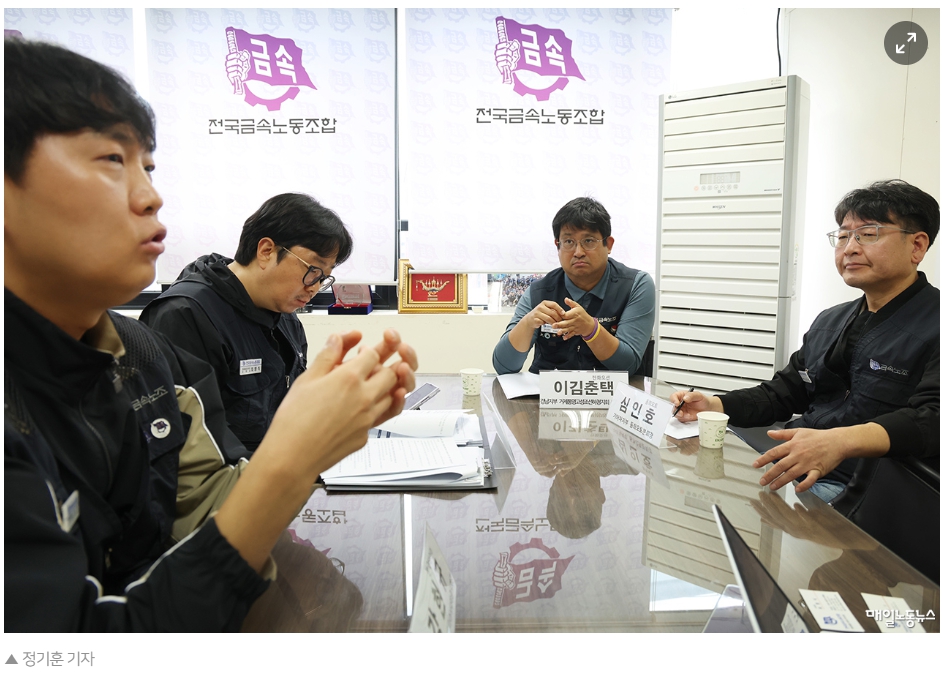
On October 12, Daily Labor News hosted a roundtable discussion at the Korean Metal Workers’ Union (KMWU) office in Jung-gu, Seoul. Participants included union representatives from subcontractor unions at Hyundai Steel, Hanwha Ocean, and Hankook Tire, as well as Donghee Auto, where all production workers are employed as subcontracted workers.
The panelists were:
- Shim In-ho, Head of the Donghee Auto Branch under the Kia Motors Chapter of the KMWU
- Choi Myung-sik, Head of the Hyundai Steel Non-Regular Workers’ Branch
- Lee Kim-chun-taek, Vice Head of the Geoje?Tongyeong?Goseong Shipbuilding Subcontract Workers’ Branch under the KMWU's Gyeongnam Regional Chapter
- Kang Hyun-gyu, Head of the Hankook Tire In-House Subcontract Workers’ Branch under the KMWU's Daejeon?Chungbuk Regional Chapter
The discussion was moderated by Lim Se-woong, a reporter for Daily Labor News.
“Union Membership Increased Once Bargaining with Principal Contractors Became Possible” ? Different Outcomes Across Workplaces
Moderator: Criticism is mounting that the Enforcement Decree and interpretive guidelines under the amended Trade Union Act have failed to facilitate effective collective bargaining. As your unions pursue bargaining procedures with principal contractors, how have conditions at your workplaces changed since the amended Act took effect? How have the Enforcement Decree and interpretive guidelines operated in practice?
Shim In-ho: At Donghee Auto, union membership increased from just four members at the beginning of this year to 350. Membership continued to grow as we pursued collective bargaining procedures.
We followed every available legal procedure in response to the company's denial of its status as an employer.
The Labor Relations Commission recognized the principal contractor's employer status and the need to separate bargaining units. When the company failed to publicly announce the union's bargaining request, we filed an application with the Labor Relations Commission for corrective action, which was also granted.
Workers began to believe that collective bargaining would finally become possible.
However, the court blocked the process. This has caused considerable confusion among our members.
The company filed an administrative lawsuit, arguing that separation of bargaining units was unnecessary.
Because filing a lawsuit does not automatically suspend an employer's obligation to bargain, the company also applied for a stay of execution of the Labor Relations Commission's review decision on bargaining-unit separation.
The Seoul Administrative Court granted that application. As a result, enforcement of the decision has been suspended until 60 days after the court delivers its judgment.
Lee Kim-chun-taek: At Hanwha Ocean, collective bargaining has actually begun.
The company denied its status as an employer and applied for a stay of execution, but the court dismissed its application.
We held our first collective bargaining session on October 8.
It is still unclear what position the company will take during negotiations. So far, the company has not raised issues such as restricting the scope of bargaining topics before negotiations. Therefore, we do not want to prejudge its attitude.
Hanwha Ocean and the Geoje?Tongyeong?Goseong Shipbuilding Subcontract Workers’ Branch held their second bargaining session on October 15.
During that session, the union presented 36 bargaining demands. At the third session scheduled for October 22, the company is expected to provide its assessment of the proposed bargaining topics.
Lee Kim-chun-taek: In fact, for minority unions such as Donghee Auto's, the Enforcement Decree, which allows bargaining units to be separated when unions belong to different higher-level organizations, is not entirely unfavorable.
Previously, separation of bargaining units was recognized only in exceptional circumstances. The government has used this mechanism to enable minority unions to bargain with principal contractors.
However, the system needs to be reconsidered.
In Donghee Auto's case, the court intervened and collective bargaining came to a halt.
Doesn't this mean that even when a union follows every procedure recommended by the government, it can still end up unable to bargain?
Moreover, the Enforcement Decree does not benefit every union equally.
Ultimately, isn't the most important issue whether subcontractor unions can actually achieve collective bargaining with principal contractors?
Choi Myung-sik: I agree.
The amended Trade Union Act has created a breakthrough and opened up certain possibilities for action.
However, those opportunities remain extremely limited.
At Hyundai Steel, the Enforcement Decree has actually delayed negotiations.
We sought to bring together the KMWU's separate workplace organizations to conduct joint bargaining with the principal contractor. Instead, the bargaining units were divided.
Negotiations were also delayed when a union representing workers at a subsidiary, affiliated with a different higher-level labor organization, pursued separation of bargaining units.
The bargaining arrangement reached by that union has also been presented to in-house subcontracted workers as a model they should accept, putting additional pressure on us.
Frustration, anger, and tension are mounting among workers.
For years, we have pursued legal action and secured court rulings requiring Hyundai Steel to directly employ our members, as well as corrective orders from the Ministry of Employment and Labor.
At the workplace, subcontracting companies openly acknowledge that they have little substantive authority. Some appear to have practically given up and tell us not to pressure them because they lack the actual decision-making power.
Kang Hyun-gyu: At Hankook Tire, we are currently engaged in collective bargaining with the principal contractor, which has taken a relatively cooperative approach.
For us, the amended Trade Union Act has created an opportunity.
In 2021, when the regular employees’ union went on strike, we had no choice but to stop working as well.
That experience demonstrated that if even one production process, whether handled by regular or subcontracted workers, is interrupted, the entire production system can come to a halt.
Meanwhile, we recently won an illegal-dispatch lawsuit filed in 2023.
The evidence collected for that lawsuit has also been useful in establishing the principal contractor's status as an employer.
Because we had never conducted collective bargaining with our subcontracting companies, the principal contractor also lacked sufficient documentation to defend its position.
Union membership increased from approximately 100 to around 500.
The company appears to be feeling pressure and has begun engaging in dialogue.
What Subcontractor Unions Are Demanding from Principal Contractors: Improved Working Conditions and Recognition of Employer Status
Moderator: Even before the amended Trade Union Act, all of your unions had argued that principal contractors were the real employers, pursuing lawsuits or demanding collective bargaining. What are your main demands in negotiations with principal contractors?
Shim In-ho: Improving working conditions is our most urgent priority.
Our key demands are higher wages through increased performance bonuses and regular bonuses, as well as reduced workloads through additional staffing.
Our annual bonus was reduced from 600% of monthly base pay in 2018 to 300%. We want it restored to 600%.
Staffing is also operated at a 100% assignment rate, leaving no additional personnel available.
Workers are subjected to extremely demanding workloads, and many suffer from musculoskeletal disorders.
Lee Kim-chun-taek: At Hanwha Ocean, resolving the low-wage problem is also our most important priority.
We are demanding nondiscriminatory performance bonuses, wages and benefits equivalent to 80% of those provided to regular employees, and annual bonuses amounting to 650% of monthly base pay.
During the shipbuilding industry's downturn, working conditions for subcontracted workers deteriorated severely.
Our demands are aimed at restoring those conditions.
The shipbuilding industry is currently experiencing an exceptional boom, but subcontracted workers' wages have not benefited from it.
Their wages remain frozen, while subcontracting companies are operating at a loss.
Hanwha Ocean provides subcontractors with advance payments against amounts that will be settled in the future. These advance payments are subsequently deducted from payments due to the subcontractors for completed work.
Choi Myung-sik: We have long been fighting to make Hyundai Steel acknowledge its illegal use of in-house subcontracted workers.
As an extension of that struggle, we are demanding direct employment and equal treatment with regular employees on occupational safety matters.
There are also practical limitations because we must repeatedly request bargaining.
Under the current system, whenever we request collective bargaining with the principal contractor each year, we must go through a process of proving and obtaining recognition of the company's employer status.
This process is almost as demanding as establishing an illegal employment-dispatch relationship.
Suppose the principal contractor's employer status is recognized for a particular bargaining topic this year and negotiations take place.
The following year, we have to repeat the same process.
Our fundamental concern is to change this structure.
Kang Hyun-gyu: Our immediate priority is to institutionalize regular collective bargaining with the principal contractor.
We want to reach agreements on matters that the principal contractor can determine, such as employment succession and occupational safety, and establish a regular bargaining process.
After a fire broke out at the factory in 2023, subcontracted workers were pressured to resign.
We also need mechanisms to prevent principal contractors and subcontracting companies from shifting responsibility onto one another.
“Bargaining Outcomes Matter More Than Further Legal Reforms” ? Focus on Expanding Union Membership and Strengthening Internal Organizational Capacity
Moderator: What actions are your unions considering or preparing to take to achieve collective bargaining with principal contractors?
Shim In-ho: While the court's decision has temporarily halted the bargaining process with the principal contractor, we intend to demonstrate our bargaining capabilities through negotiations with subcontracting companies.
Through this process, we aim to recruit more union members.
Normally, wage and performance-bonus negotiations begin this month and conclude with an agreement toward the end of December.
We want to demonstrate what our union can achieve through these negotiations.
As membership has grown at Donghee Auto, we have secured the status of exclusive bargaining representative at one of the 11 subcontracting companies operating at the workplace.
At the other 10 companies, unions affiliated with different higher-level labor organizations conduct collective bargaining with an employers' association representing the subcontractors.
We will negotiate separately with the subcontracting company where we hold representative bargaining status.
Through collective action, we intend to secure higher wages and performance bonuses than those obtained by the other unions.
If separate negotiations fail to produce results, we will continue pursuing procedures through the Labor Relations Commission.
Lee Kim-chun-taek: We are considering how to expand union organization.
Rather than focusing solely on bargaining with the principal contractor, we are looking for ways to make such bargaining a foundation for the long-term expansion of union membership among subcontracted workers.
However, we have not yet found a clear answer.
Subcontracted shipyard workers are often more concerned about the disadvantages they might face by joining a union than the benefits membership could bring.
We do not know whether receiving substantial settlement payments or bonuses would encourage unionization, or whether the mere fact that subcontracted workers have negotiated directly with the principal contractor would be meaningful enough to expand membership.
If securing a collective agreement is itself meaningful, we may conclude our first collective agreement with the principal contractor this year.
Nevertheless, beginning this year, conducting annual collective bargaining and concluding collective agreements will undoubtedly create multiple opportunities to organize subcontracted workers.
Choi Myung-sik: Internally, we are developing a medium- to long-term strategy.
At this stage, rather than focusing on further legislative or institutional reforms, we need to strengthen our internal organizational capacity and turn our plans into concrete action.
We are currently negotiating with the subcontracting companies.
Once those negotiations are completed, we intend to press Hyundai Steel strongly for direct employment.
Our counterparts include executives who previously worked at Hyundai Steel or Hyundai Motor and have extensive backgrounds in labor relations management.
They are approaching the employer-status issue in a deliberate and systematic manner.
We must be prepared to respond.
I believe that once we exercise our right to take industrial action, there is no telling when the dispute will end.
We intend to consolidate differing views within our organization.
Kang Hyun-gyu: Our union has grown considerably.
We continue to demonstrate to our members that a larger union can resolve unreasonable practices and workplace problems.
We intend to maintain that momentum while also securing the legal right to take industrial action against subcontracting companies.
At present, the principal contractor is trying to bring the subcontracting companies into the bargaining process.
We believe this is intended to shift responsibility for individual bargaining topics onto the subcontractors.
We will work to prevent that.
Until the end of the year, we will make every effort to incorporate our demands through dialogue.
If negotiations fail, we intend to plan strike action.
Reporter: Lim Se-woong Published: October 19, 2026, 6:30 a.m. Email: imsw@labortoday.co.kr
Source: Daily Labor News Website: https://www.labortoday.co.kr
| No | Title | Date | Access | File |
|---|---|---|---|---|
| 356 | Notice A Pioneer of Korean-English Labor Law Content: [Interview] Bongsoo Jung, Certified Labor Attorney at KangNam Labor Law Firm | 25.07.25 | 8068 |

|
| 355 | Notice 10 Top Lawyers In Seoul For English-Speaking Foreigners (April 27, 2022): KangNam Labor Law Firm was selected as one of ten best law firms in Seoul by the International Magazine. | 25.03.07 | 6892 |
|
| 354 | Notice Regarding Legislation to Extend the Mandatory Retirement Age: A Conversation between Dr. Jun-Ki Han and Labor Attorney Bongsoo Jung | 26.09.03 | 277 | |
| [Roundtable on the Amended Trade Union Act ? Manufacturing Subcontractor Unions] “We Followed the Labor Ministry’s Guidelines, Only to Be Blocked by the Court” What Are the Concerns of Subcontractor Unions at Donghee Auto, Hankook Tire, Hanwha Ocean N | 26.10.19 | 101 |
|
|
| 352 | [Exclusive] Complaints Over Illegal Dispatch and Disguised Subcontracting Surge 2.7-Fold in Three Years 292 complaints filed in 2025 and 174 in the first half of 2026, while the prosecution rate falls to just 6.9%. N | 26.10.13 | 403 |
|
| 351 | Back on the Ground After 194 Days: First Step Toward Excluding Taxi Drivers from the Deemed Working Hours System | 26.10.12 | 520 |
|
| 350 | Salary Negotiations from the Employer’s Perspective (SMEs and Startups): How to Address Differences Between Job Applicants’ Salary Expectations and the Company’s Salary Budget. | 26.10.10 | 499 | |
| 349 | Measures to Address Employee Disagreement with Performance Evaluation Results in a Performance-Based Compensation System: | 26.10.10 | 462 | |
| 348 | KOSAF to Bargain with Call Center Workers Following National Labor Relations Commission Ruling Principal Employer Status Recognized for “Protection of Emotional Labor Workers” … First Meeting with the General Service Workers’ Union Scheduled for Oct | 26.10.07 | 520 |
|
| 347 | Reward for Reporting Fraudulent Wage Payment Claims Increased to KRW 200 Million Amendment to the Enforcement Decree of the Wage Claim Guarantee Act Approved … Labor Minister: “We Will Enhance the Sustainability of the Substitute Payment System” | 26.10.07 | 454 |
|
| 346 | Performance evaluation is at the core of human resource management: Management by Objectives (MBO) vs. Objectives and Key Results (OKR) | 26.10.04 | 576 | |
| 345 | Amendment to the Occupational Safety and Health Act Passes the National Assembly ? Companies with Repeated Industrial Accidents Face Fines of Up to 5% of Operating Profit | 26.10.03 | 892 | |
| 344 | Seven Dismissed Workers of Korea Optical High Tech Have Appealed to the Supreme Court | 26.10.01 | 1558 | |
| 343 | Collective Bargaining Agreement Between the Korean Financial Industry Union and Financial Companies: Banking Hours from 9:30 a.m. to 4:00 p.m. and a 3% Wage Increase | 26.09.30 | 1323 | |
| 342 | Dismissal During the Probationary Period: | 26.09.29 | 1164 | |
| 341 | “Are Safety Helmets Being Worn Properly?” Labor Ministry to Inspect 1,000 Workplaces | 26.09.29 | 1079 | |
| 340 | Basic Labor Standards Violations Exceed 18,000; 63.7% of Employment Contract Violations Occur at Workplaces with Fewer Than 30 Employees | 26.09.28 | 968 |
|
| 339 | Procedures for Establishing a De Facto Marriage and Related Protections: | 26.09.27 | 637 | |
| 338 | Artificial Intelligence and Human Resources Management ? Discussing the Future of Work | 26.09.27 | 621 | |
| 337 | Happy Chuseok holiday! | 26.09.27 | 600 |