
Long Road Ahead for Sickness Benefits: “Coverage Must Be Expanded and Benefits Increased” Public hearing held ahead of nationwide implementation in the second half of 2027
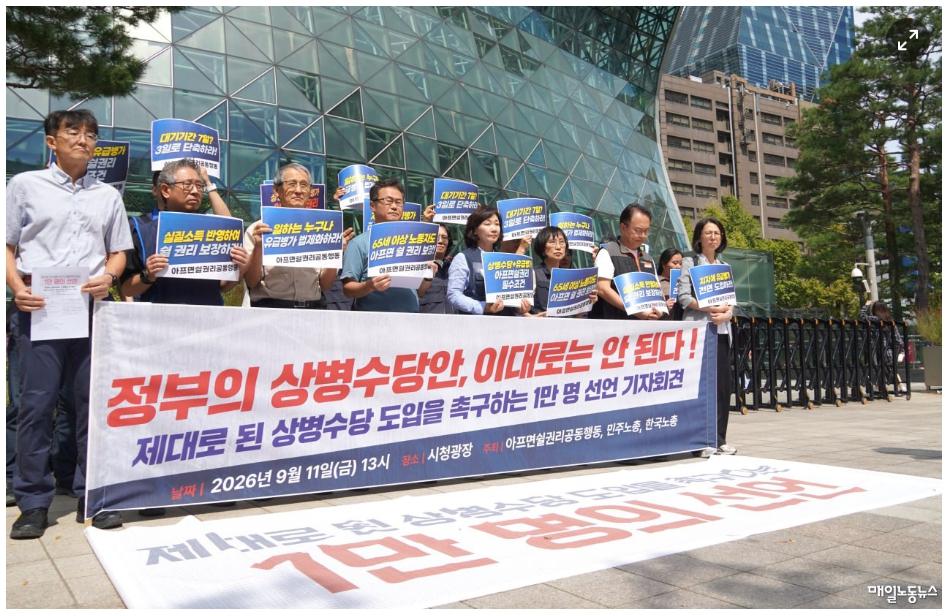
▲ The two major trade union confederations and the Coalition for the Right to Rest When Sick held a press conference at Seoul City Hall Plaza on the afternoon of September 11 under the slogan, “The Government’s Sickness Benefit Plan Is Not Enough! Declaration of 10,000 People Calling for a Proper Sickness Benefit System.”
<Coalition for the Right to Rest When Sick>
The Ministry of Health and Welfare held its first public hearing ahead of the nationwide implementation of the sickness benefit system in the second half of next year. Labor groups and civil society organizations argued that the government should broaden eligibility for the benefit and increase the level of income replacement.
Pilot Program “Confirms” the Effectiveness of Sickness Benefits
The Ministry of Health and Welfare and the Korea Institute for Health and Social Affairs held a public hearing on the afternoon of September 11 at the President Hotel in Jung-gu, Seoul, where they presented the results of the sickness benefit pilot program.
The sickness benefit is a system designed to compensate workers for lost income during periods when they are unable to work due to non-occupational illness or injury.
The government launched the pilot program in 2022 for employed persons aged 15 to 64 and has gradually expanded it. Since July of last year, employees enrolled in the National Health Insurance employee scheme have been entitled to receive 60% of their previous income, while those covered by employment or industrial accident insurance, as well as self-employed persons, receive an amount equivalent to 60% of the minimum wage. There is currently a seven-day waiting period following the onset of an illness or injury, after which benefits may be paid for up to 150 days.
According to data released by the National Health Insurance Service at the hearing, a total of 14,365 people received approximately KRW 20.803 billion in sickness benefits between the launch of the pilot program and July of this year. Each recipient received benefits for an average of 30.5 days, amounting to approximately KRW 1.45 million per person. Of the 24,483 applications submitted, benefits were paid in 22,883 cases, representing an approval rate of 93.5%. Among recipients, 65.6% were non-regular workers, while 48.6% worked at small and medium-sized businesses. This indicates that the program has in fact benefited workers in vulnerable employment situations.
The proportion of recipients who were able to receive timely medical treatment increased by 17.1 percentage points, while the proportion who received sufficient treatment rose by 16.9 percentage points. Park Ji-young, head of the NHIS Sickness Benefit Promotion Division, said, “Low-income, non-regular and older workers at small workplaces that do not provide paid sick leave have been the primary beneficiaries of the sickness benefit program,” adding that the system “has contributed to creating a culture in which people can rest when they are sick and receive treatment in a timely manner.”
Scope of Coverage and Benefit Levels Remain Key Issues
At the public hearing, concerns were raised first about eligibility. Critics argued that the age limit of 65 should be abolished and that eligibility should not depend solely on whether an individual is covered by social insurance. Kim Heung-soo, co-representative of the Coalition for the Right to Rest When Sick, said, “More than four out of ten people aged 65 or older are still working, and even among those over 80, one in five continues to work.” He added, “Older workers generally require longer recovery periods and face a greater risk that their illnesses will become severe, meaning that their need for sickness benefits is actually greater.”
Kim continued, “The purpose of sickness benefits is not to provide a pension to people insured under the National Health Insurance system, but to protect people who lose income because illness prevents them from working.” He warned that “if eligibility is designed primarily around insurance status, platform workers, freelancers, workers in special types of employment and small-scale self-employed workers could be excluded.”
There have also been calls to shorten the current seven-day waiting period to three days.
The waiting period refers to the period between the date on which a person becomes unable to work due to illness or injury and the date on which sickness benefit payments begin. Its purpose is to prevent abuse of the system by excluding short-term illnesses and minor medical conditions from coverage.
Na Baek-ju, co-representative of the Health Right Network, said at a press conference held before the public hearing jointly with the two major trade union confederations under the slogan “Declaration of 10,000 People Calling for a Proper Sickness Benefit System”:
“A seven-day waiting period means that infectious diseases such as COVID-19, for which isolation generally lasts no more than about a week, would effectively fall outside the protection of the system.”
He added, “ILO Convention No. 130 provides that, even where a waiting period is imposed, it should not exceed three days.” Labor and civil society organizations also called for the maximum benefit period to be extended from the current 150 days to as long as 18 months and for the income replacement rate to be increased from the current 60% to 66.7%. Choi Mi-ra, Executive Vice President of the Federation of Korean Trade Unions, said, “Eligibility for sickness benefits should be broad, barriers to access should be low, and income protection should be sufficient.”
By Eom Jae-hee September 14, 2026, 6:30 a.m. eom@labortoday.co.kr
Source: Korea Labor & Society Institute / Maeil Labor News (Labortoday)
| No | Title | Date | Access | File |
|---|---|---|---|---|
| 328 | Notice A Pioneer of Korean-English Labor Law Content: [Interview] Bongsoo Jung, Certified Labor Attorney at KangNam Labor Law Firm | 25.07.25 | 7871 |

|
| 327 | Notice 10 Top Lawyers In Seoul For English-Speaking Foreigners (April 27, 2022): KangNam Labor Law Firm was selected as one of ten best law firms in Seoul by the International Magazine. | 25.03.07 | 6683 |
|
| 326 | Notice Regarding Legislation to Extend the Mandatory Retirement Age: A Conversation between Dr. Jun-Ki Han and Labor Attorney Bongsoo Jung | 26.09.03 | 110 | |
| 325 | Notice PRACTICAL KOREAN LABOR LAW IN ENGLISH: 6-Week Case-Based HR Course | September?October 2026 · 4th Term | 26.08.09 | 752 |

|
| Long Road Ahead for Sickness Benefits: “Coverage Must Be Expanded and Benefits Increased” Public hearing held ahead of nationwide implementation in the second half of 2027 N | 26.09.14 | 11 |
|
|
| 323 | Local Government Labor Inspectors to Inspect Workplaces with Fewer Than 30 Employees Starting December 2026: N | 26.09.12 | 64 | |
| 322 | Support for Foreign Entrepreneurs: Pangyo Gyeonggi Startup Center I provided consultations to a total of six teams at the Pangyo Gyeonggi Startup Center. N | 26.09.11 | 106 | |
| 321 | We meet with Advisor Haeseon Kim, who has been serving as an advisor to KangNam Labor Law Firm for more than three years. N | 26.09.09 | 252 | |
| 320 | “Will They Ignore Even the Final Ruling Confirming 176 Contractual Working Hours?” Seoul Bus Union Says Employers Have Failed to Keep Their Promise … Accuses Them of Disregarding Binding Supreme Court Ruling and Insisting on “230 Hours” N | 26.09.09 | 307 |
|
| 319 | “Recognition as an Employer Has Led Us Nowhere”: Healthcare Workers’ Union Suspends Group Bargaining Delays in Labor Relations Commission procedures and disputes over the scope of bargaining stall negotiations … Union shifts to workplace-by-workplace N | 26.09.07 | 281 |
|
| 318 | Regarding Legislation to Extend the Mandatory Retirement Age: A Conversation between Dr. Jun-Ki Han and Labor Attorney Bongsoo Jung | 26.09.03 | 372 | |
| 317 | Medical Solidarity Headquarters Marks 20 Years of “Steps Toward Public Healthcare and Care” Publishes a 20-year history of the hospital labor movement, followed by a book talk and anniversary ceremony | 26.09.02 | 387 |
|
| 316 | A Conversation Between Labor Attorney Bongsoo Jung and Attorney Sang-Yung Park | 26.09.01 | 343 | |
| 315 | Interview between Dr. Bongsoo Jung and Dr. Junki Han ? Differences between Human Resources Management and Labor Relations Management | 26.09.01 | 351 | |
| 314 | One in Five Employment Insurance Subscribers Falls into ‘High AI Exposure’ Group Lawyers Rank No. 1 in AI Exposure … Employment Slowdown Driven More by Youth Population Decline | 26.09.01 | 334 |
|
| 313 | Concerns Over “Workplace Surveillance” Persist Even After Work Electronic Monitoring Encroaches on Workers’ Daily Lives … Workplace Gapjil 119 Calls for Regulation Under the Labor Standards Act | 26.08.31 | 254 |
|
| 312 | Adding an AI Search Keyword to KangNam Labor Law Firm’s Business Cards: “Korean Labor Attorney” | 26.08.28 | 303 |
|
| 311 | Standard Contract Introduced for Supermarket Delivery Drivers: “A Minimum Framework for Negotiating Working Conditions” Distinction Between Primary and Ancillary Duties and Standards for Delivering Heavy Goods Also Established | 26.08.27 | 301 |
|
| 310 | With My Friend Dave ? A Dear Canadian Friend Who Has Faithfully Helped Me with My English Writing for the Past 20 Years | 26.08.25 | 361 | |
| 309 | ‘DC Retirement Pension → IRP at Another Provider’ Transfers to Become Easier Task Force Launched to Improve In-Kind Transfers of Retirement Pensions… Funds with Suspended Redemptions May Also Become Transferable | 26.08.25 | 376 |
|